According to cybersecurity specialist Surfshark, over $1 billion was lost worldwide in 2025 to fraud involving fake videos, images, or voices generated by AI. This surge is affecting TV presenters in France, as well as business executives and scientists.
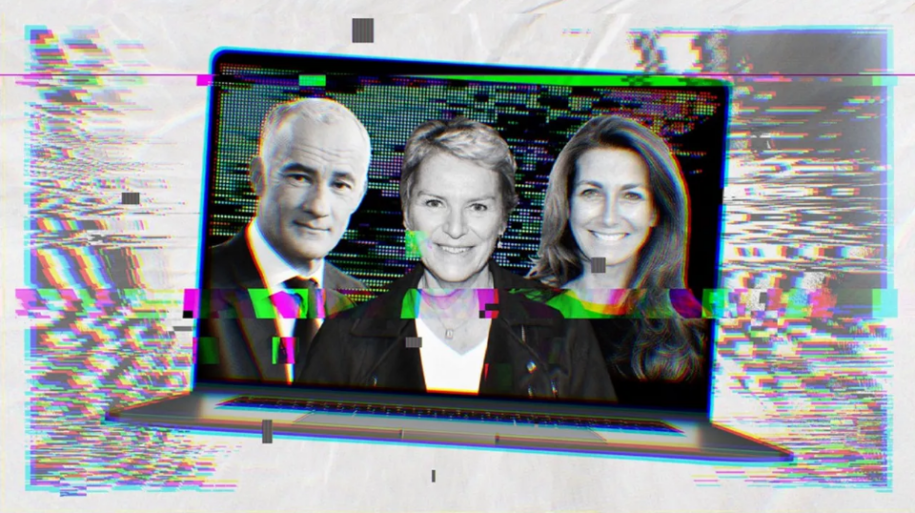
Élise Lucet, Gilles Bouleau, and Anne-Claire Coudray are among the most targeted TV personalities by deepfakes in France. (Collage Alexia Mayoux for “Les Echos” / Photos iStock and Sipa)
By Fabio Benedetti Valentini and Marina Alcaraz
Published on Feb. 5, 2026
Élise Lucet knocking out the Governor of the Banque de France, Brigitte Bardot making a fortune through a trading platform, a miracle solution discovered by Michel Drucker… Curious to know more? Dying to click? That’s the whole point. And if you do click, you’ll be redirected to investment offers in cryptocurrencies or other risky assets, as well as fake weight-loss programs.
These types of scams have skyrocketed in recent months. According to data from Blue Efficience, a company that works with TF1 and France Télévisions, 293 viral “fake contents” were identified on social media in France in January, twice as many as in November.
Over a Billion Dollars Lost
Despite the complaints filed by France Télévisions in recent months, the phenomenon “is far from winding down, and it could gain momentum with the upcoming municipal elections,” explains Gautier Curtil, head of digital communications for the public broadcasting group.
The “artificial” Élise Lucets have very real consequences: over $1 billion vanished worldwide in 2025 due to deepfake fraud, fake videos, images, or voices created with AI, according to cybersecurity firm Surfshark. That’s three times more than in 2024 and nine times more than in 2020. “The adoption of AI tools and their ease of use have amplified the phenomenon,” points out Luis Costa, head of research at Surfshark.
However, the actual scope is likely even larger, as the study only counts publicized cases. Roughly 80% of total deepfake-related losses are linked to the impersonation of political figures (scammers are particularly fond of Donald Trump or Elon Musk) or movie and TV “stars”, the fake Brad Pitt made a notable splash, for instance.
In France, beyond the host of Cash Investigation, Gilles Bouleau and Anne-Claire Coudray are frequently targeted. But television isn’t the only industry affected. Popular YouTube influencers as well as corporate executives are also being hit.
The CEO of Doctolib learned this the hard way in late January. “A deepfake video using my face has been circulating on social media over the past few days. It pitches a miracle investment opportunity disguised as a fake TF1 evening news broadcast. That is not me,” warned Stanislas Niox-Chateau on LinkedIn.
“What makes this technology dangerous is the combination of three elements that are advancing very rapidly: video realism, voice cloning, and automated production. The real cost is a collapse of trust. When you can no longer believe what you see, you don’t believe anything anymore,” he added.
Scientists are also being targeted. We’ve seen “fake doctors selling miracle cures or academics spouting lies. In the United States, John Mearsheimer is one prime example. This international relations specialist spent months asking YouTube to take down hundreds of these hyper-realistic edits attributing controversial statements to him on hot geopolitical issues,” notes AFP. “A Herculean effort.”
YouTube points out that impersonation is strictly prohibited under its “Community Guidelines.” The platform is developing tools to protect creators against AI-driven deception.
Meanwhile, several French networks (TF1, France TV, France 24, etc.) have recently partnered with Blue Efficience, a French service provider, to detect and remove deepfakes. “Our policy is to protect our onscreen talent and our audience. As a trusted news source, having the fastest possible response time is essential,” explains Julien Laurent, Chief Digital Officer at TF1Info.
Increasingly Sophisticated Scams
Scams are becoming ever more sophisticated. Just recently, a fake article on a site mimicking Le Figaro reported a clash between Élise Lucet and the Governor of the Banque de France, complete with quotes attributed to economist Julia Cagé, among others, and a link to an investment platform. To bypass social media filters like Facebook’s, this type of post is disguised inside one of the variations of a much more conventional ad (in this case, for clothing).
Yet, laws do exist. The French Penal Code provides for prison time (at least 1 year) and fines, with stiffer penalties in cases involving sexually explicit edits.
“With deepfakes, there can be two tracks: criminal law, involving several possible offenses, forgery, fraud, defamation, etc. and civil law, to seek damages,” explains Patrice Navarro, attorney at Clifford Chance. “Additionally, platforms are required to promptly remove problematic content,” even if forcing them to do so can take time. In short, “the legal toolkit exists; the challenge is finding the culprits, who are often behind screens abroad.”